Ireland's Bioeconomy: now less principled! now with biomethane!
In October, at the major Global Bioeconomy Summit 2026 in Dublin the Taoiseach, Micheál Martin, Minister for Agriculture, Martin Heydon and Minister for Climate, Energy and the Environment, Darragh O’Brien launched Ireland’s 2026 National Bioeconomy Strategy, lets call it the 2026NBS.
This major update to Irish bioeconomy policy follows on from the 2018 National Policy Statement on the Bioeconomy (2018NPSB) and the 2023 Bioeconomy Action Plan (2023BAP).
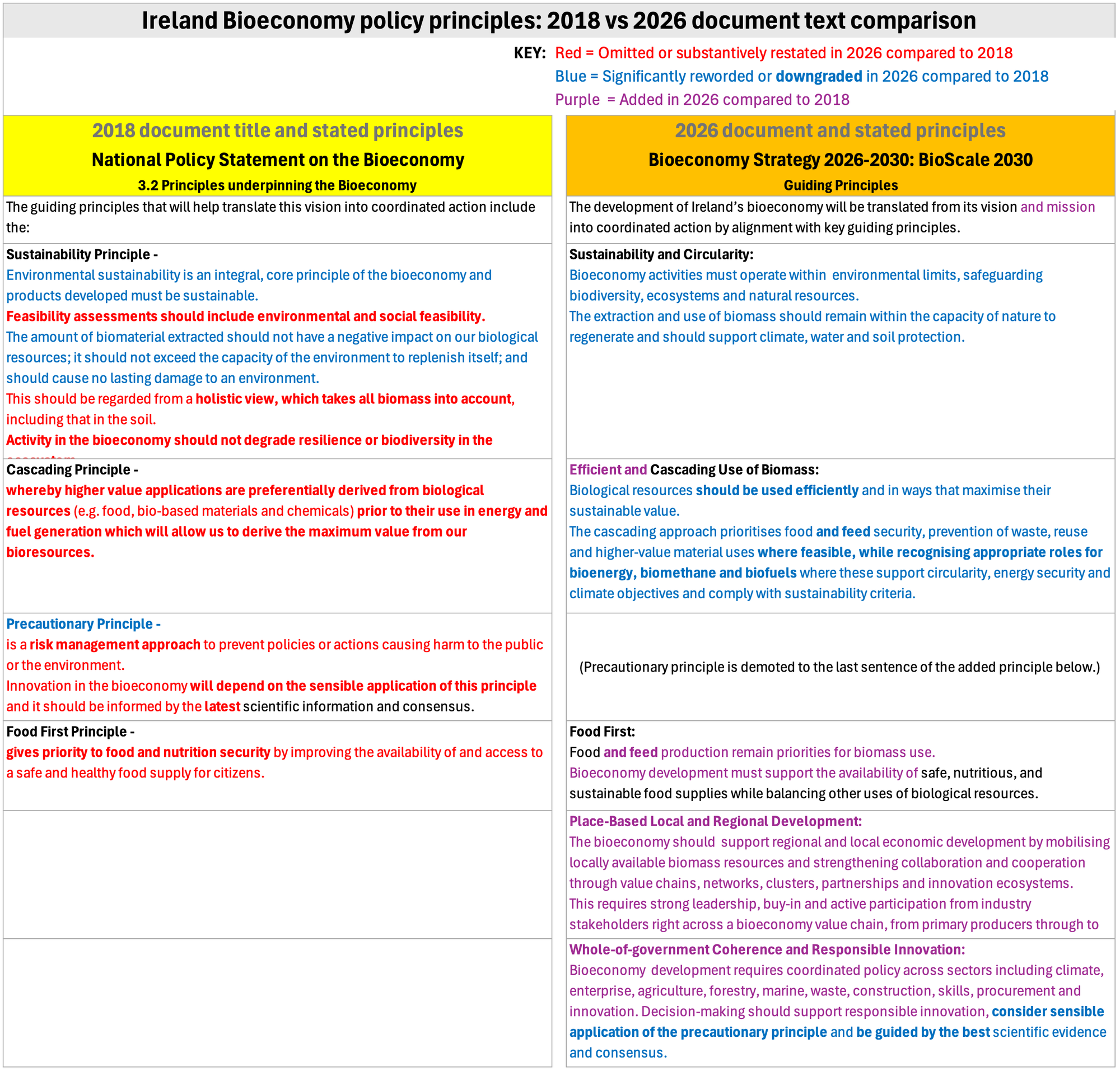
The post takes a look at how Ireland's 2018 NPSB bioeconomy guiding principles for careful use of biomass have transmogrified – as in, to transform or shapeshift in a surprising a magical manner – into the considerably different guiding principles stated in the 2026NBS.
Competing biomass demands require clear prioritisation
If Ireland is serious about breaking its fossil fuel addiction then – as well as decarbonising fossil fuel energy use (using solar and wind energy with storage backup) – defossilising necessary food, clothing, plastics and chemicals uses will also be crucial. That means the carbon in these uses would have to come from processing plant biomass that has captured carbon from the atmosphere.
The trouble is, the amount of potentially available and additional biomass that could be allocated for defossilisation – without further degrading soils, ecosystems and food security – is extremely limited. For global and national production, a 2025 UK cross-sector study states, "Even optimistic [biomass] estimates fall far short of the potential demand from energy, chemicals, materials, aviation, shipping, and land-based carbon sequestration". Thus it concludes:
Competing demands require clear prioritisation.
Without guidance, biomass deployment risks repeating the extractive patterns of the fossil-based economy. Food production and ecosystem services must remain the highest priorities due to their foundational social value. Beyond these, the optimal uses of biomass are those where no viable low-carbon alternatives exist, where biomass can deliver significant greenhouse-gas reductions, and where its molecular complexity provides unique functional or material advantages. Conversely, technologies where electrification, recycling, or renewable hydrogen can provide the same service should not rely on biomass.
In short, very clear guidelines for biomass use are needed: first of all to ensure use-prevention (by limiting demand); then to prioritise biomass for high value uses, such as feedstocks to defossilise non-fuel production; and, crucially, to specifically avoid developing low value biomass uses, such as biomass leading to combustion as fuel for energy. The latter low value use of course includes using manure-silage feedstock for biomethane production in anaerobic digestion (AD) plants, especially as solar-wind-storage renewable electrification of energy services is now so much less costly.
Pyramidal graphics are often used to illustrate this critical decision hierarchy. The UK study highlights Moerman’s Ladder for food waste and the Waste Hierarchy for general waste usage. In Ireland, the 2023 EPA report, Circular Bioeconomy Outlook Study 2030–2050, led by Professor Kevin O'Connor at UCD, displays an even clearer biobased value pyramid for prioritising biomass uses, as shown below.
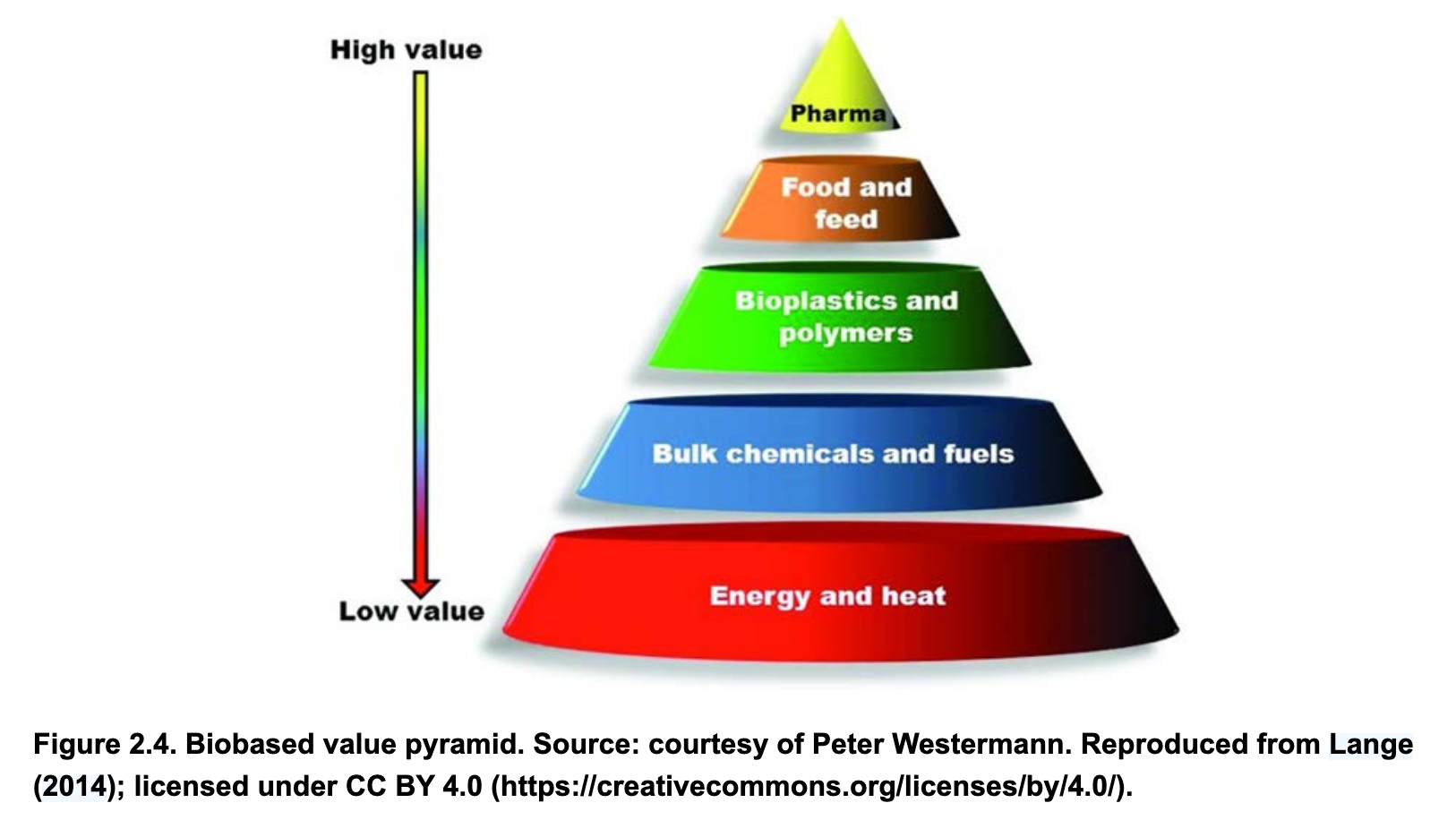
This research-based hierarchy had already been well summarised in the 2018NPSB's four "Principles underpinning the bioeconomy": sustainability, cascading use (prioritising high value use); precautionary risk management to avoid harms; and food first for nutrition security. The 2023 Bioeconomy Action Plan restated the 2018 principles with no changes except an addition on local/regional development.
For the hierarchy presented by scientific research and the 2018NPSB principles, my largecaps-takeaway summary of the principles is, DO NOT USE BIOMASS TO PRODUCE FUELS FOR ENERGY OR HEAT!
Trouble is, compared to the 2018 NPSB principles and text, the key changes in the new 2026BPS update can be summed up as: DO USE BIOMASS TO PRODUCE FUELS FOR ENERGY OR HEAT.
Most especially, the 2026 changes can be seen to support the (highly questionable) government policy for roll-out of a national-scale system of 150–200 anaerobic digestion plants using biomass (cattle slurry and grass silage) feedstocks, primarily to produce biomethane trucked for injection into the national gas grid operated by Gas Networks Ireland toward a 2030 biomethane target of producing 5.7 TWh/year.
So what happened to Ireland's bioeconomy guiding principles between 2018 and 2026? Let's take a deeper look at the pdf texts.
Comparing texts: Ireland's 2018 bioeconomy principles versus the 2026 update
The two tables below compare the full quotes of the guiding principles, first in the 2018 NPSB and then in the 2026BPS update. My highlights, in red, blue, purple and boldface, respectively indicate omissions, restatements, additions, key descriptions. (I've done this fairly quickly but aiming to be accurate.)
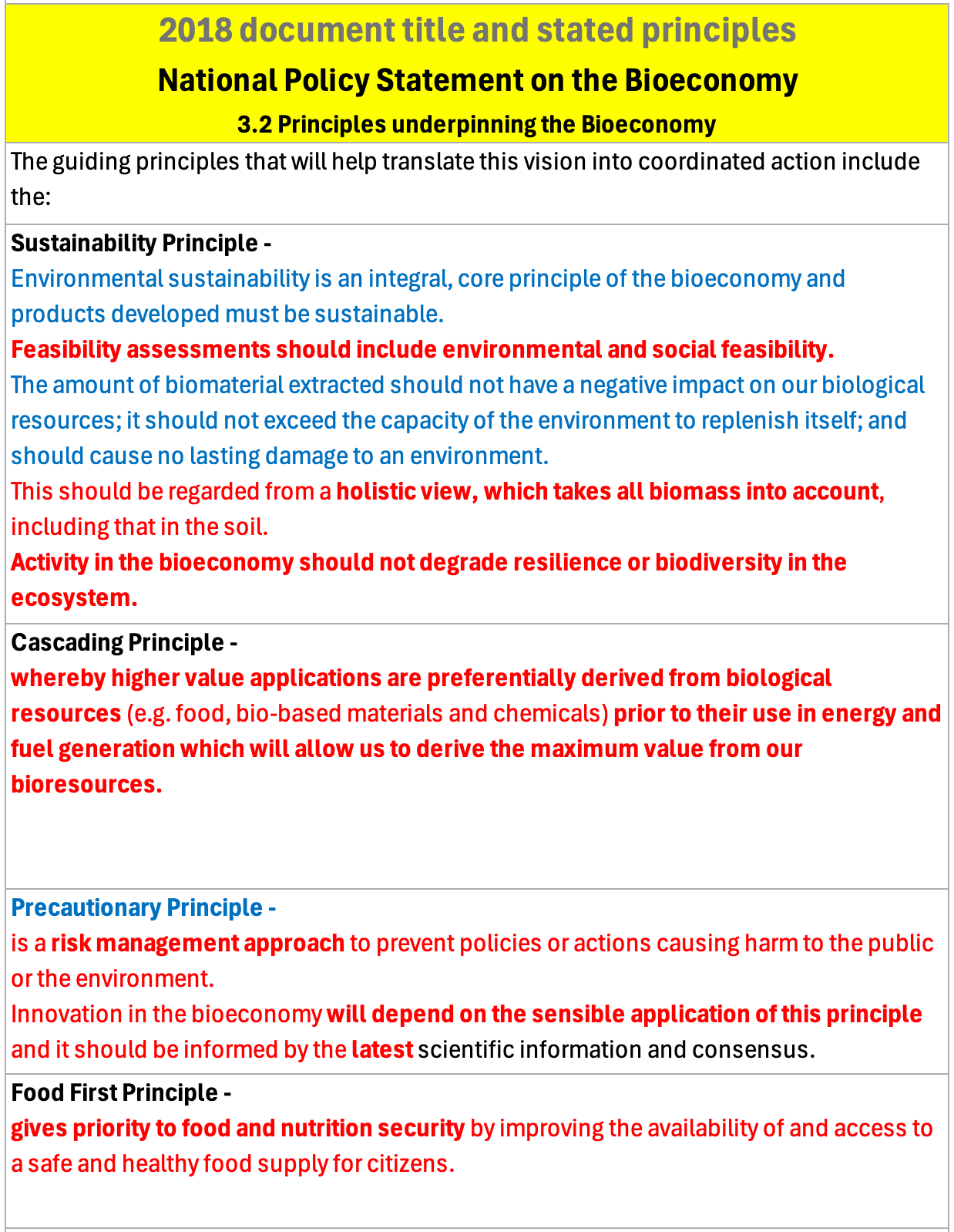
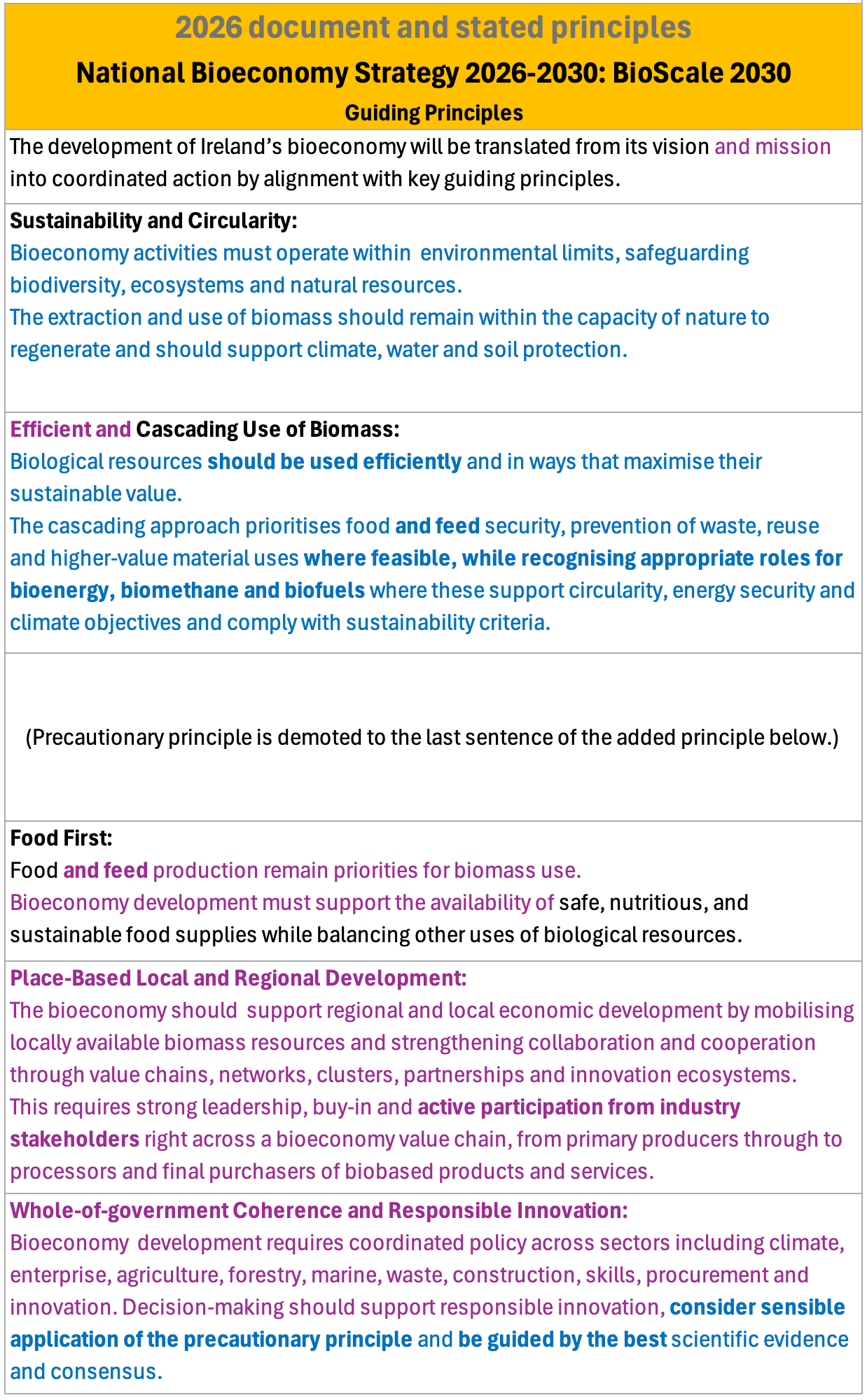
As confirmed by the subsequent O'Connor et al. EPA report, Ireland's 2018 National Policy Statement on the Bioeconomy did a good job of following the biomass use prioritisation hierarchy from academic and expert literature in its policy framework by setting out its four clear principles underpinning the bioeconomy.
But, as shown in the text comparison above, it is remarkable to observe the reduction in text clarity regarding biomass prioritisation seen in the 2026 update. One could spend a full academic article going through all of the changes – feel free anyone to do that! Here, I'll just focus on the degradation of the cascading and food-first principles, the ones that requires prioritisation of high-value uses of biomass for food and critical chemicals over using biomass to produce fuel for energy uses.
Strikingly, the terms bioenergy and biomethane never appear in the 2018NPSB principles, nor even in its full text, yet in the 2026NBS they appear once each in the principles, and 26 times and 12 times respectively in the full text.
In the 2018NPSB guiding principles, the meaning of cascading is very clearly stated as meaning:
whereby higher value applications are preferentially derived from biological resources (e.g. food, bio-based materials and chemicals) prior to their use in energy and fuel generation which will allow us to derive the maximum value from our bioresources. (2018NPSB)
The 2026NBS does not state the cascading principle's meaning at all. Instead the language appeals unclearly to undefined terms, efficiency and sustainable value, and even suggests that reuse and higher value use are only directed on a 'where feasible' basis. The full quote is:
Biological resources should be used efficiently and in ways that maximise their sustainable value. The cascading approach prioritises food and feed security, prevention of waste, reuse and higher-value material uses where feasible, while recognising appropriate roles for bioenergy, biomethane and biofuels where these support circularity, energy security and climate objectives and comply with sustainability criteria. (2026NBS)
But there is strong scientific evidence and policy experience to suggest that there are no such "appropriate roles" for biomethane. Multiple negative and deeply compromising issues for large-scale AD biomethane promotion have been identified. For example, in Ireland, the EPA submission to the biomethane strategy here and the ten notes (by me) at the end of the An Taisce statement here.
Most obviously, AD biomethane energy production is massively more costly and less efficient than farming solar energy for the same ultimate energy consumption. Just based on Teagasc's own estimates, using land for PV solar farms is 35 times more land efficient than using it for grass-clover silage biomass as a feedstock for biomethane. By rough calculation, compared to AD biomethane, using solar PV for heat via heat pumps produces more than 4.5 times the heat energy from an eighth of the land area proposed for AD silage. In which case, the remainder of proposed AD silage land and the monies for AD policies could instead go to high value uses, such as human-edible food crops and permanent continuous forest via rewilding for biodiversity and ecology restoration, which would also provide more secure (less burnable/windfallable than-sitka) carbon storage too.
The SEAI have made clear that burning biomethane for electricity is a very poor use of a high-value resource. Supposedly market mechanisms like Renewable Gas Guarantees of Origin (gGOs) will direct biomethane toward uses for heat rather than electricity, but of course all of the biomethane injected into the gas-grid just mixes with the (99+%) fossil methane in the gas grid that goes to supply all uses including electricity generation.
As a result, contrary to SEAI advice, most egregiously, and fantastically, the Commission for Regulation of Utilities (CRU) is allowing data centres to buy gGOs to pretend they have achieved "100% natural gas decarboinization [sic] with biomethane". You couldn't make it up.
In short, it's far more land efficient, and can thus be far more ecologically responsible, to farm energy with cheaper solar PV for electricity rather than grass-clover silage for expensive AD biomethane.
So why is biomethane now a centre-piece of the 2026NBS.
So much for principles?
From the simple text comparison above, it's evident that the 2026 National Bioeconomy Strategy represents a major devaluation of Ireland's bioeconomy guiding principles, most obviously in favour of AD biomethane production, but also in favour of producing animal feed.
As per the above-referenced EPA and NGO statements, the evidence base for the Government's strong policy commitment to large scale AD biomethane and its use of land and feedstock production appears to be very poor. That indicates an extraordinary lack of due diligence by the key departments (Agriculture and Climate) and agencies (Teagasc and SEAI) that have enabled substantial AD biomethane policy supports to proceed.
Already the consequence of those weak evaluations is being seen in substantial commitments of public money and policies for AD biomethane: a further €2oo million in the most recent budget (adding to a previous €19 million and the €40m RePowerEU capital fund) and, coming soon, a costly Renewable Heat Obligation (RHO) to support AD biomethane, ultimately funded by increased consumer energy prices.
Counter-intuitively, much of this money has been sourced from a so-called Infrastructure Climate and Nature Fund. Given the issues with AD biomethane and its feedstocks – AD plant methane leaks, perpetuating emissions intensive dairy farming and worsening land use efficiency to name just three – that's a very questionable use ring-fenced of climate and nature funding.
So why has this debasement of principles happened? One clue is in the added principle for "Place-Based Local and Regional Development" which emphasises a requirement for "active participation from industry stakeholders right across a bioeconomy value chain, from primary producers through to processors and final purchasers of biobased products and services".
By comparison, "sensible application of the precautionary principle" will merely be considered, in a downgrade from the primary status of precautionary assessment in 2018. In contrast, the update's guiding principles' revisions indicate a new bias toward industry and away science-informed precaution.
Such inbuilt governance bias becomes a pattern of behaviour. In late 2023, the Departments of Agriculture and Climate gave presentations ahead of releasing the National Biomethane Strategy declaring that they had consulted with "all stakeholders", when in fact relevant stakeholder experts and environmental NGOs likely to be critical had not been consulted at all. In an open letter to the departments, An Taisce pointed out that "Such bias seriously risks the appearance of regulatory capture of NBS development by vested interests." The Strategy's planned direct issuance was notably then cancelled and delayed to issue a draft for public consultation.
Our governmental civil service has to deliver Government policies but under the Civil Service Code it is also pledged to act with "integrity, impartiality, effectiveness, equity and accountability", because to do otherwise is likely to result in very costly misdirection of State time and monies.
By setting out an overtly biomethane-friendly 2026 National Bioeconomy Strategy, revised in favour of biomethane contrary to the 2018 NPSB principles and without any acknowledgement that solar PV is now five times cheaper, the Departments of Agriculture and Climate are again giving a persuasive picture of regulatory capture by vested interests.
It might be a good idea to ask why this expensive AD biomethane boondoggle is occurring.
Follow the money?
Journalists might want to follow the money and look at what sectors and actors are benefiting most from the AD biomethane push. Most obviously, that's business-as-usual intensive pasture-and-silage farming and Gas Networks Ireland.
For AD feedstocks, dairy farming gets to dump and monetise its winter slurry, and pasture beef farmers get paid for producing silage to make up for the cattle rearing lost to feedlot reared dairy-beef.
Contrary to the climate and energy system analysis identifying the importance of rapidly winding down the gas-grid, GNI gets to (improbably) suggest that AD biomethane is its path to net zero emissions to get its costly ten-year plans approved by the CRU and gets to be paid for running a scheme to claim the AD biomethane is 'renewable'.
And of course, industrial users of gas for heat, like dairy processors using gas for milk powder production, and data centres, absurdly for on-site gas-fuelled electricity generation, get to buy 'renewable gas' certificates to greenwash their large energy usage.
By wild coincidence, the leading non-government sponsor for the Global Bioeconomy Summit 2026 – its "Platinum Partner" – was Gas Networks Ireland. The three day summit programme was mostly devoted to high value biomass uses, such as food ingredients and other non-energy uses, but GNI kept a low profile. They hosted only one session (Biomethane - how to scale up renewable gas), with one other session (Where Next for Biomethane and the Bioeconomy?) – from industry lobby group Renewable Gas Forum Ireland, of which GNI is a leading member.
The Global Bioeconomy Summit was focused on addressing the cascading principles for biomass use even as Ireland's new National Bioeconomy Strategy (coming with the additional title BioScale2030 for extra confusion) was shrouding them in foggy language to promote AD biomethane, a worst-case use.
Meanwhile, solar PV and energy storage costs are plummeting while the Irish public are being saddled with the AD biomethane system's massive cost-inefficiency as yet another subsidy to protect the vested interests of existing livestock agriculture, big land owner/operators, and fossil fuel delivery.
To sum up: the crucial science-based bioeconomy cascading use prioritisation principles of the 2018 NPSB have been slyly rewritten in favour of a 2026 National Bioeconomy Strategy that is supportive of continued business-as-usual profits for the intensive livestock agri-food industry and Gas Networks Ireland.
A low-carbon transition is delayed yet again. So much for principles.
Paul Price, 3 November 2026