When the facts are a problem, intensive livestock defenders don't want you to know them
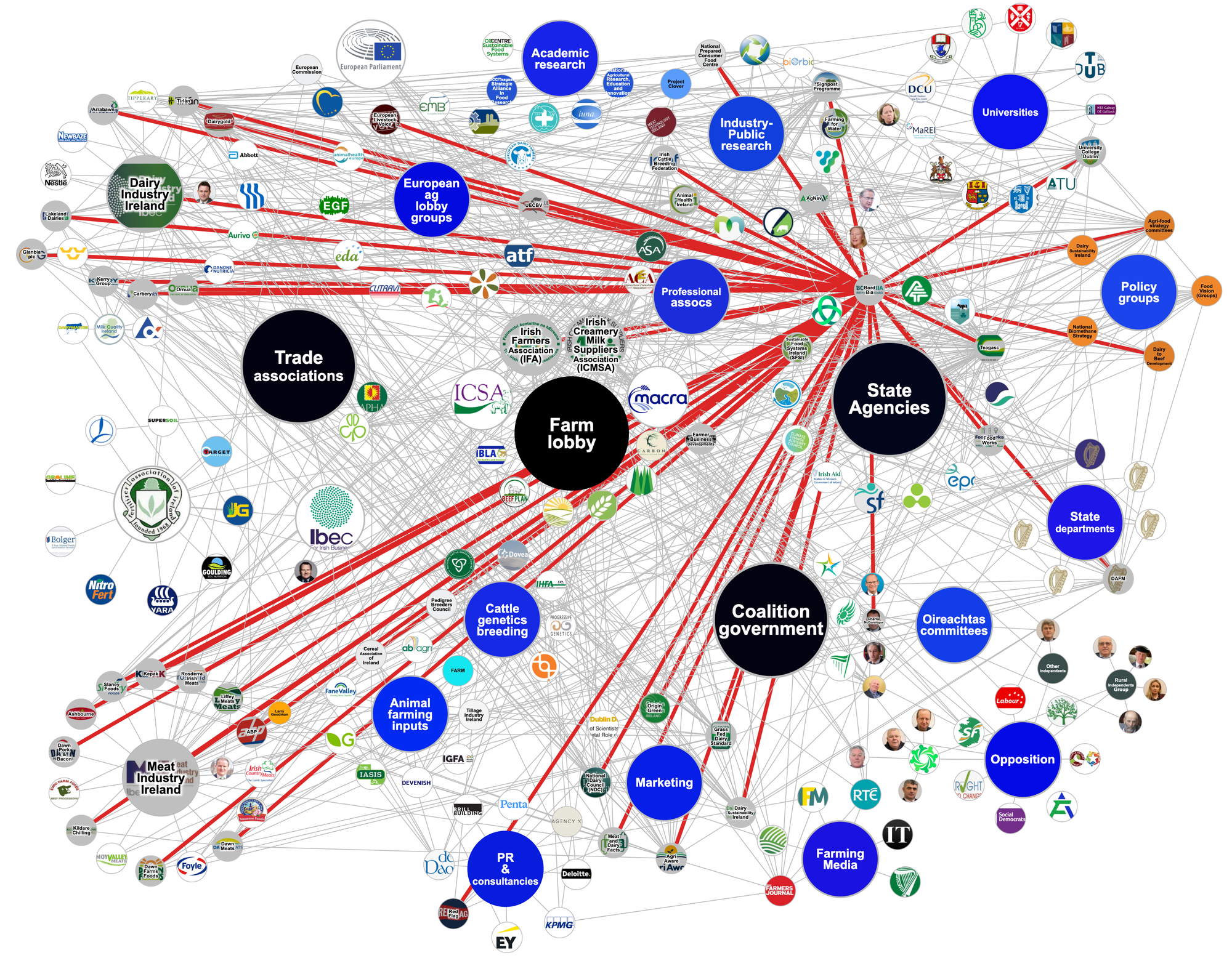
Abundant research and reporting has documented how the fossil fuel industry was extremely well informed about the large global heating impact of its oil, coal and gas production—most notably, through its early own scientific research. Despite having "excellent scientists" to provide this deep understanding, the fossil fuel majors intentionally adopted the 'tobacco strategy', a massive campaign of public misinformation to delay regulation of their industry.
"Doubt is our product...", repeatedly questioning scientific certainty by emphasising claimed unknowns in scientific studies and reporting, has been a primary misinformation tactic of polluting industries, and the intensive livestock meat and dairy industry does the same thing. Climate science findings make clear that limiting animal based food production and consumption globally is now a critical policy requirement to avoid dangerous climate change.
As a new journal paper documents, the cattle industry has been highly aware of its climate impact for many decades, especially the large warming effect of its methane emissions. Worried that the public would change what they ate away from meat and dairy, the industry adopted multiple communication strategies to divert public attention from the problematic climate and environment impact of intensively produced animal source foods.
A more recent example of livestock agri-food industry efforts is the 'Dublin Declaration' (DD), launched by an Irish Government minister at a 2022 conference hosted by Teagasc, Ireland's supposedly independent scientific agricultural advisory.
Of the DD signatories, 27 from Ireland signed on to its message that critics were making livestock systems "the victim of simplification, reductionism or zealotry". That's quite the 'poor me' claim being made by researchers and advisors strongly associated with one of the most powerful industrial sectors in the world, one which has been very successful in delaying climate action.
The DD (and Teagasc's involvement) has been widely critiqued in peer-reviewed journal papers (also here), expert commentary, NGO investigation, and other detailed reporting. Nonetheless, its lead authors have continued to double down on the messaging. The most recent DD effort is a Substack blog by DD leads, including Professor Alice Stanton in Ireland, proclaiming DD success and a commitment to science.
Well let's have a quick look at one recent example of that claimed DD commitment to science.
A classic of 'doubt is our product' messaging
A recent DD blogpost entitled, 'The scientific courage to say “We do not know” shines through FAO’s latest report on Terrestrial Animal Source Food'. Written by DD primary movers Peer Ederer & Frédéric Leroy, responds to the latest Report on Terrestrial Animal Source Food from the UN Food and Agriculture Organisation (FAO).
But oddly, for such scientifically courageous folk, they fail even to provide a weblink to reference the report. The FAO Report, entitled, Contribution of the livestock sector to food security and sustainable agrifood systems, the third in a series. It presents a great deal of scientific information and expert analysis, and yet Ederer and Leroy insist that "Its most courageous statement, repeated many times, is this: We do not know."
This DD blog catches the eye as a classic of the 'doubt is our product' genre by stressing scientific uncertainty. Rather than actually reporting the FAO's findings they instead deploy cherry-picked talking points that favour the intensive-input livestock industry.
For example, they say "measured per kilogram of milk or meat, the heaviest environmental footprints in the world today are found in the poorest livestock systems", followed by this gem:
The innovation that improves those herds will come from where productivity is high today. Dismantling the rich world’s livestock base will not liberate capacity for the poor – it will demolish the workshop in which the poor world’s escape route is being built.
This rhetoric is most obviously diversionary because it overlooks the gross inequality between the poor and rich world in farmer access to fertiliser and feed. As shown in the chart below, a clear illustration of this is in global dairy systems research that shows that in poorer nations cows often produce only a 1,000 litres of milk per year, or much less, when even a small increase to 3,000 litres would drastically reduce emissions per cow if they had the forage and feed to do so.
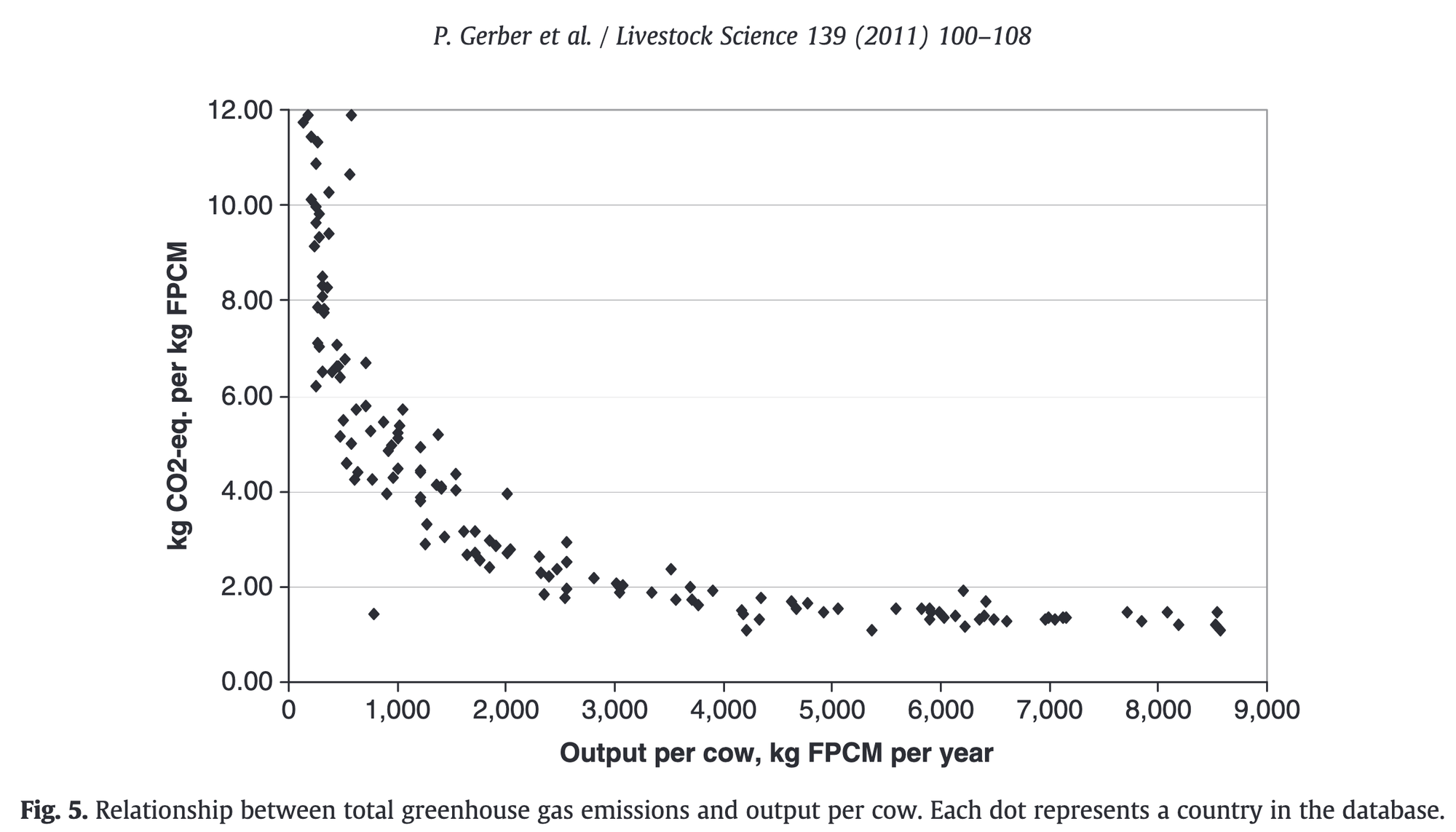
Crucially, the chart also shows that there are only very small gains in GHG efficiency beyond that relatively low production level, meaning that the claimed innovation efficiency improvement of rich-world intensification to cows providing as much as 10,000 litres per year is minimal. As a thought experiment, the chart suggests that a big decrease in global dairy emissions could be gained on the basis that for each intensive cow and its 10,000 litres per year removed from production, rich countries could provide sufficient feed for 5 cows produce 3,000 litres per year each. So much for intensive livestock efficiency?
The DD blogpost concludes in full doubt-is-our-product mode:
In light of the known unknowns, a precautionary principle should apply, and the 3 FAO reports on Terrestrial Animal Source Foods provide the foundation for it. The precautionary principle not to further weaken functioning, time-proven food systems, and to treat theories whose models have yet to prove themselves with a lot more caution.
This makes it very clear that Ederer and Leroy are very much in favour of keeping business-as-usual livestock production ticking along as-is, especially it seems as practiced by the largest rich world farmers and profiting the largest animal sourced food corporations.
Given all the array of authoritative science pointing out the climate and biodiversity importance of transitioning away from intensively produced livestock-sourced food, Ederer and Leroy are here also deploying a jaw-dropping inversion of the precautionary principle. Contrary to their implication, the core point of the principle is to avoid enabling systems, including existing ones, that result in serious potential environmental and human harms, even in the absence of full information.
So is there any beef in the FAO report? Why yes there is
Entitled, Contribution of the livestock sector to food security and sustainable agrifood systems, the FAO report — the third published of four planned — presents plenty of expert knowledge to chew on.
Here let's just focus on two FAO findings that Ederer and Leroy seem keen to avoid: (1) negative issues with the rich-world livestock systems that they espouse; and (2) the place of terrestrial animal source food production within the global food system.
"High-external-input dependent livestock production systems" – some benefits but many negatives too
The FAO report uses the term 'high-external-input dependent livestock production systems' to describe intensive livestock (meat) and dairy milk production systems that have high input-related impacts (land, feed and fertiliser uses) and intensive animal grazing or feedlot systems.
Searching the report's pdf for that descriptor gives 145 hits, so, as a sample, here's a few of the first quotes that come up, with my emphasis added to highlight the FAO findings for intensive systems:
Mixed crop–livestock production systems contribute to all three dimensions of sustainability (economic, social and environmental), as well as to resilience and the circular bioeconomy, while high-external-input-dependent production systems receive more support due to their higher economic contribution.
Consumers often place more trust and value in local products and products with geographical indications than those from large-scale high-external-input dependent production systems. These latter systems have little connection with their social environment except for employment; they occasionally generate controversies in terms of quality of life and lead to social tensions or conflicts.
High-external-input dependent livestock production systems often harm biodiversity due to high resource use and practices such as monoculture, while low-external-input-dependent production systems can enhance biodiversity.
High-external-input-dependent livestock production systems mostly rely on concentrate feed, which depends almost fully on water from irrigation, thereby potentially straining water sources.
Low-external-input-dependent livestock production systems with low stocking rates emit less GHG per unit of surface area and less ammonia per kg of excreted nitrogen. High-external-input-dependent livestock production systems generally have lower GHG emission intensities per kg of product or per kg of crude protein.
(Note how the DD blogpost only points to the higher efficiency per kilo for intensive production, and yet fails to point out the higher per hectare efficiency of low intensity production and lower ammonia pollution.)
While high-external-input-dependent livestock production has enabled more efficient production, it has also influenced risks for several diseases due to multiple interconnected factors, including high concentrations of animals, stress and immune suppression, selective breeding for specific production traits (often with less resilience to disease), and lack of genetic diversity. Consequently, these systems must rely even more on contemporary animal disease prevention and mitigation measures.
(Note again, how the DD blogpost only refers to intensive system efficiency but fails to note the multiple negatives for resilience that require greatly increased tolerance of animal-health issues and greater pharmaceutical use and monitoring.)
High-external-input-dependent livestock production systems often lead to biodiversity loss, while practices like extensive grazing and silvopastoral systems can promote biodiversity.
Relocating small-scale producers into the labour force for large scale, high-external-input-dependent production systems is a policy recommendation provided by the World Development Report (Byerlee et al., 2008); however, small-scale producers and pastoralists have warned that these practices would absorb only a small number of labourers and would result in a loss of livelihoods and food sovereignty (Gura, 2008).
And there are many more clear conclusions in the FAO's report detailing the nature and impacts of 'high-external-input-dependent' livestock production systems – many of them negative or cautionary.
But you get the idea. The report straightforwardly documents major issues with the rich-world intensive livestock systems that the DD proponents are so anxious to defend. Of course, good scientists would fairly document evidence and directly address counter arguments to their findings. It may only be a blogpost but it's revealing that Ederer and Leroy's don't do this.
Losses and loss rates in the global agrifood system – inside Table C7
Here's a striking quote from p.130 of the FAO report that the DD authors might not want emphasise:
When feed production is taken into consideration, loss in livestock production systems is significant (see Table C7). There are two major reasons for this: first, feed production involves the addition of extra supply chain stages during processing and transportation; second, producing plants to be fed to livestock is principally inefficient compared to direct human consumption (Alexander et al., 2017; Wilkinson, 2011).
That's not a message the DD or its authors want to acknowledge. In Ireland, the supposedly 'grass-based' 'family farm' system is in reality an industrial landscape of rye-grass monoculture, requiring very large inputs of imported fertiliser and feed for dairy production, and most beef is now sourced from the dairy industry and increasingly finished in feed lots by the major meat processors.
As shown in the screenshot below, the noted Table C7 is well worth a look. It starkly presents the global level data that evidences the enormous losses and inefficiencies of livestock systems worldwide in terms of mass, energy, and protein. It's worth noting that nitrogen is the critical element in protein and the mass of protein is directly related to the mass of constituent nitrogen), so protein mass loss is a good proxy for nitrogen loss, and nitrogen losses are a major source of climate and environmental pollution.
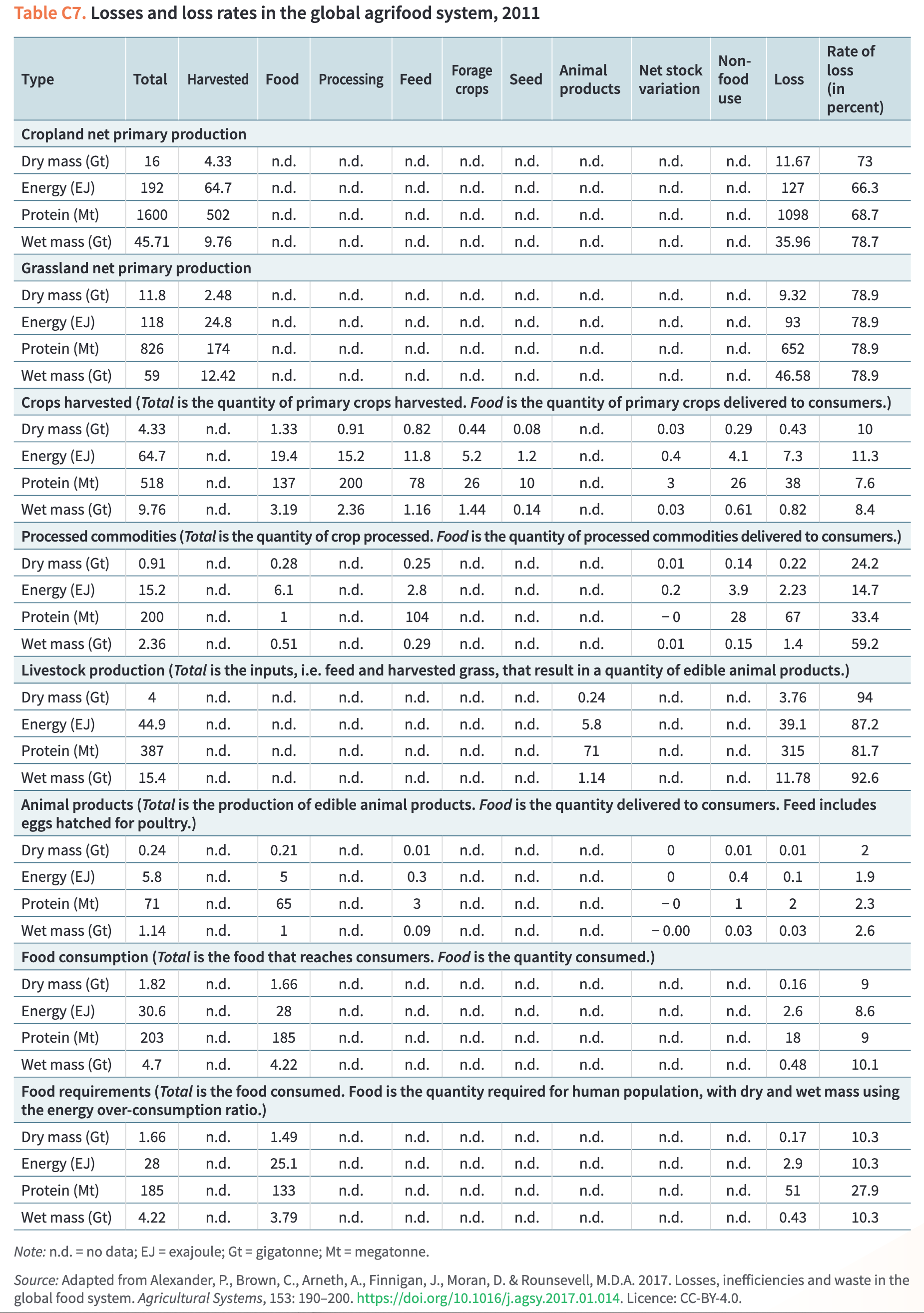
Looking at Crops harvested and Processed (crop) commodities, the percentage of total mass lost before delivery to consumers is about 13%.
Compare that with the massively greater 94% mass loss for livestock: inputs of 4 gigatonnes; losses of 3.76 gigatonnes; total animal products 0.24 gigatonnes. The likewise staggering losses for energy and protein are 87% and 82%, respectively.
The FAO's summary comment and this Table's evidence on livestock's extraordinarily high food-inefficiency are not what we hear from the livestock industry, the DD proponents, or Teagasc here in Ireland, but they are statements of the obvious for anyone with even minimal knowledge of the extraordinary food-wastefulness of intensive livestock agri-food systems.
The bottom line is that we can at least question whether intensive livestock production can be fairly described as 'food' at all.
In Ireland, Teagasc researchers acknowledge that the limited amount of human-edible feeds fed to Irish animal needs to be subtracted from the livestock industry's gross output of calories and protein, and on that basis they claim that climate policy would cut protein access. However, they fail to acknowledge that if all the fertiliser and tillage-suitable land currently used to grow grass and feed were used to grow food instead then it's entirely likely that Ireland's livestock industry does not produce any net food at all. Indeed, even before Ireland's outlier intensive dairy expansion, that was the finding of Dr. Colin Doyle in 2016, based a straightforward analysis of FAO and IPC C data.
So, the term 'food' needs to be interpreted with more care by media and generally, especially in relation to the output of extremely wasteful, linear input-output livestock systems. It's a good idea to be very careful before accepting simplistic and, yes, reductionist 'feed the world' claims by Ireland and the like especially if they amount to profiting by (overwhelmingly) exporting to other rich nations by using high-impact feed imports that consequentially undermine the ability of poorer nations to feed themselves.
Summing up: 5 Ds + DD = BAU
Politically powerful, highly polluting incumbent industries and high emitting countries become Merchants of Doubt that enable favourable propaganda to maintain their public acceptability, to keep the profits flowing and economies growing, no matter their large and often growing consequent GHG and ammonia emissions and wasted-nutrient water pollution.
For decades, scientists and NGOs have sounded the alarm by calling out the livestock industry's push to downplay its methane emissions and its worsening of water and air contamination.
But, the livestock industry is following the fossil fuel playbook, globally, and in countries like Ireland and New Zealand, where national governance is always strongly influenced by a powerful livestock agri-food industry. By adopting the tobacco strategy to resist regulation via increasing its advertising spend the public and the media is constantly persuaded to ignore the need for policy action to limit the industry's power and pollution.
Despite agriculture being the highest GHG emitter and rapidly declining water quality, Ireland's publicly funded food advisory, Bord Bia, funds international trade show efforts around the world that benefit the big meat and dairy processors. They even coordinate livestock industry campaigns, including dodgy faux rap videos (verging on self-satire!) and advertising that questionably proclaims the industry's sustainability,
The key elements of the strategy to prolong business-as-usual (BAU) profits are the 5 Ds: denial, diversion, distraction, doubt and delay. Ironically — as in their blogpost's own demonstration of simplification, reductionism and zealotry — the Dublin Declaration just adds two more Ds to the list.
If we are serious about food security – for all Irish households and globally – and about a sustainable future for farming, then it's long past time to recognise and limit the influence of the intensive livestock industry and its biased PR efforts.