Did Ireland meet Carbon Budget 1? Some key caveats and why CB2 is the real policy test
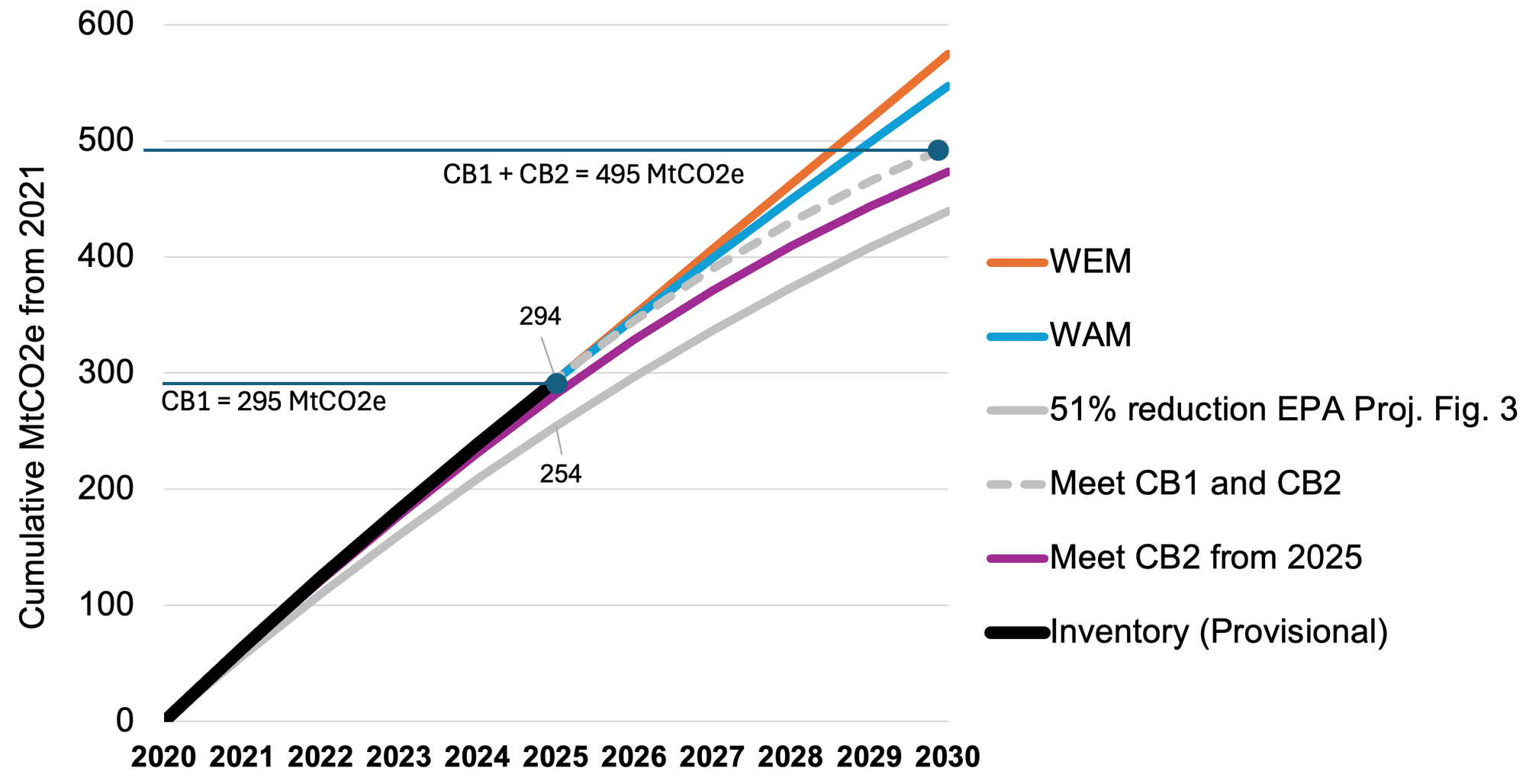
In July EPA issued its report on Ireland’s Provisional Greenhouse Gas Emissions 1990-2025, stating that the first statutory five-year carbon budget (CB1) of 295 MtCO2e, covering 2021–2025 had been met:
"Provisional emission estimates for the years 2021 to 2024, in addition to national total emissions including LULUCF for 2025 in this report, represent 293.9 Mt CO2eq or 99.6% of the first five-year carbon budget of 295 Mt CO2eq. This leaves 1.1 Mt CO2eq of the budget available to be carried over into budget 2 for 2026-2030."
The EPA does excellent and important work in delivering Ireland's GHG emissions data and reporting, but this post briefly sets out some important caveats affecting this claimed achievement, which could best be foregrounded as part of this headline statement and detailed further in this and other reporting from the EPA and other advisory bodies.
Above all, CB1 was always supposed to be relatively easy compared to the large investments and system changes required to meet the second carbon budget CB2 for 2026–2030, a limit of 200MtCO2e inclusive, as adjusted for CB1 exceedance or success.
Storm forest windthrow losses almost certainly break the CB1 budget
As the Provisional report states in section 4.7 LULUCF, the 2025 emission value for LULUCF (Land Use Land Use Change and Forestry) merely repeats the 2024 value and, crucially it fails to account for the forest losses due trees blown down by Storms Darragh (Dec 2024) and Eowyn (Jan 2025):
"It is not yet known the full consequences of Storms Darragh (Dec 2024) and Eowyn (Jan 2025) in terms of the forest carbon stock. The volume of timber windthrown in these events is equivalent to what would typically be felled over a 2.5-year period."
Coford, the forest sectory advisory body, states that "[h]arvest removed each year amounts to 2 to 3 Mt CO2". Therefore, the EPA's estimated 2.5 years felling equivalent for storm windthrow loss in 2025—not included in the Provisional reporting, could easily amount to an additional 6 MtCO2—and the amount may well be more when soil carbon emissions from the windthrow area are included. That scale of adjustment would bring the expected 2021–2025 provisional emissions to about 300 Mt, breaking CB1 with an exceedance of about 5 MtCO2. Under the 2021 climate Act this exceedance has to be applied as a reduction to CB2 which then becomes 195 MtCO2e.
Even though the storms' windthrow loss emissions had not been estimated at the time of the report, the likely budget-breaking caveat was stated only later in the Provisional report, it was not stated alongside the EPA report's CB1 achievement claim. That's given the unhelpful impression that CB1 was met when in fact the storm losses very likely break the budget.
CB1's accounting benefit – very little to do with climate action policy
The EPA reports emissions for 1990 onward based on many sub-sector quantities (areas, usage etc) and their related emission factors. When new peer-reviewed science updates the quantities or factors then the entire time-series for the sub-sector is recalculated. This is particularly important for Ireland's carbon budgets and the constituent sectoral emission ceilings (SECs) because they depend on total and sectoral emissions in 2018 as the base-year.
The 2021 EPA inventory value for 2018 for total emissions was to 68.2 MtCO2e (as adjusted from AR4 to AR5 GWP100 values) and this was used in 2021 by the Climate Change Advisory Council (CCAC) in recommending the carbon budgets later approved by the Oireachtas as legally binding.
However, due to scientific updates the 2026 Provisional report update now presents a substantially lower 2018 value of 64.5 MtCO2e. Past EPA National Inventory Documents explain that the key reasons for the update are a substantial reduction in LULUCF emissions, especially due to reduced Forest land emissions, and a lesser but still significant reduction in Agriculture emissions, due to a reassessment of beef cattle feed intake.
There is no one 'right' way to estimate the effect of this 2018 update on carbon budget but a simple method is to compare five years of stable emissions at the each given 2018 level with the CB1 value of 295 MtCO2e. For the adjusted 2021 EPA value for 2018 of 68.3 MtCO2e, five-years at this rate would be 341.5 MtCO2e, which is 46.5 MtCO2e more than CB1. By contrast, for the 2026 value of 64.5 MtCO2e, the five-year total would be 322.5 Mt, which is 27.5 MtCO2e. Thus, the accounting change has reduced the necessary cumulative reduction by 19 MtCO2e, a 'windfall' benefit toward meeting CB1 of more than a third of the 46.5 MtCO2e that had been required.
Another way to look at it is as a straight line reduction in annual emissions from the 2018 value to a 2025 value that results in cumulative 2021–2025 emissions equal to CB1's 295 MtCO2e – see Figure 1 below with these pathways. For the original 68.3 MtCO2e in 2018, meeting CB1 requires annual total emissions to reduce each year by 1.86 MtCO2e, to reach 55.3 MtCO2e in 2025, which is 19% less than the 2018 value. By contrast, for the revised 2026 value of 64.5 MtCO2e in 2018, meeting CB1 requires annual total emissions to reduce each year by 1.11 MtCO2e, to reach 56.8 MtCO2e in 2025, which is 12% less than the 2018 value. Over the five year carbon budget period, the revision reduces the required mitigation to meet CB1 by 0.75 MtCO2 per year or 3.75 MtCO2e in total.

Either approach shows how there has been a sizeable 'windfall' benefit due to the accounting change to 2018 total emissions, so the new 2026 Provisional value for the base year 2018 has made CB1 easier to meet.
(As evident in the above chart though, what has not changed is the far greater rate of whole-society and all-sector mitigation delivery— not just aspirational plans—needed from now on to achieve anything close to meeting CB2.)
The crucial point is that this accounting benefit has nothing to do with any positive effect of climate action policy or any other real world effects, it is simply a scientific adjustment. As a consequence, one might expect that the carbon budgets CB1 and CB2 would need to be adjusted as they were recommended by the CCAC using the earlier 2018 basis, but following the climate Act it is the agreed budgets that are binding so they are not about to be changed, at least as of now.
Nonetheless, a fair reporting of CB1 achievement should at the very least make very clear that the inventory accounting adjustment to 2018 total emissions, its causes (in land use and agriculture science updates), and the scale of its resultant 'unearned' benefit toward meeting CB1, add up to a very significant caveat on the claimed CB1 success. It is to be hoped that the EPA can be clearer in future in explaining and quantifying the accounting effects of scientific updates on carbon budget achievement.
Imported electricity may not count as Irish emissions but let's be clear on the resultant emissions 'saving' and why it is being imported
Imported electricity—via the three 500 MW interconnectors to the UK and the future 700 MW Celtic interconnector between Ireland and France—is reported as having zero emissions because electricity generation is accounted on a territorial production basis.
The CCAC is explicitly recommending increasing electricity imports to enable meeting the Electricity sectoral emission ceiling (SEC) as the UK and France have much lower carbon intensities for electricity generation: "2024 values of 226 g CO2/kWh in Ireland, 124 g CO2/kWh in the UK and 22 g CO2 eq/kWh in France".
(In other words, Ireland can buy part of the way to meeting the SEC by importing electricity because replacing fossil-fuel-fired—mostly gas-fired—is going too slowly and demand, especially from data centres is going up too quickly relative to domestic generation from more renewable energy. It seems a better idea to place far stronger system limits on data centres demand, which we know are not aligned with meeting Ireland's climate targets.)
Even if accounted as zero emissions, importing electricity does have an emissions cost in the source country and a financial cost for Ireland that we would do well to acknowledge more explicitly than just accepting its zero emissions rating as a convenient benefit to climate action without detailed comment. Below is my table from SEAI Energy in Ireland reports' data, as I read it (corrections welcome) – it shows a 2024 carbon intensity value for Irish generation close to but not quite as high as the CCAC's stated value.

Based on this table, Ireland's net import of electricity over 2021–2025 would have emitted an estimated 3.6 MtCO2e if it had been generated in Ireland. In effect, the import saved this amount of emissions toward the achievement of CB1 and the Electricity SEC.
Conclusion: caveats are crucial in assessing carbon budget achievement claims, it's best be clear and not leave them out
From the 2021 CCAC modelling the recommended CB1 was intended to be relatively easy to meet to allow time for the necessary decisions and investments to ensure delivery of the much more challenging CB2. Nonetheless, the CCAC 2021 carbon budget recommendation report stated:
The proposed 5-year budgets therefore are designed to and would enable the target emissions in 2030 to be met in a manner that is technically feasible and has less impact on society as a whole. However, given that action slowly ramps up across the decade and given the time-lag between policy implementation and actual emissions reductions this requires substantial interventions to start immediately. – p.26 in CCAC Carbon Budget Technical Report October 2021
Therefore, coming close to meeting CB1 is not a great cause for legitimate pride, especially when there are very serious caveats to the CB1 success claim, and if the policy implementation and investment is not already in place to achieve the high rate of emissions reduction—above all via fossil fuel phase out and cutting fertiliser use—that is urgently required to meet the much harder CB2.
The EPA 2026 Projections report makes clear that current and proposed policies in existing climate action plans fall far short of what is required for CB2. Recent reporting indicates that many commitments by Government have just not happened, the updated climate action plan is more than eight months overdue, and the effectiveness of the climate Act is being actively undermined by explicit disapplication in several current Bills proposed by the Government.
So it's important to avoid fooling ourselves when there are evidenced reasons for caution. This post looks at three caveats—are there others?—that require clearer reporting as a key part of the CB1 achievement claim:
- It is likely that CB1 was not in fact met because as-yet-uncounted windthrow carbon losses from two major storms may result in a substantial exceedance of perhaps about 5 MtCO2e. This exceedance would need to be deducted from CB2.
- Scientific updates that have nothing to do with climate action achievement have had a substantial impact (at least 3.75 MtCO2 due to the updated 2018 emissions value) in making CB1 easier to meet.
- Imported electricity is correctly accounted as having zero emissions in production accounting, but the 'saved' emissions can be estimated by comparison to it being domestic generated (about 3.6 MtCO2 for 2021–2025) and the cost of imports can be quantified to give greater context.
And, just as importantly, it is difficult to quantify the difference between effective climate policy outcomes and non-policy effects that decrease emissions, such as extreme weather (as 2018 for Irish agriculture), geopolitical events (COVID-19, Russia's invasion of Iraq, America's attacks on Iran), or EU policy uncertainty such as the potential loss of Ireland's Nitrates derogation.
Depending on bad things happening is not a good climate policy. And greater clarity on carbon budget achievement to date (or not) can help us make more effective decisions now. Meeting CB2 is becoming very difficult, but it would be best to set out a plan to do so without fail—not just WEM or WAM failure scenarios—in the next Climate Action Plan.
That would help chart a more secure path to a more resilient and more climate just future, and give us clearer information to make better choices more quickly; to do what is necessary to meet the CB1 and CB2 targets up to 2030 without fail, targets that the Oireachtas agreed, across political parties, to be legally binding.
Paul Price – 4th August 2026